How to Sear Cubes of Beef
How To Sear Meat Properly
We independently select these products—if you buy from one of our links, we may earn a commission. All prices were accurate at the time of publishing.
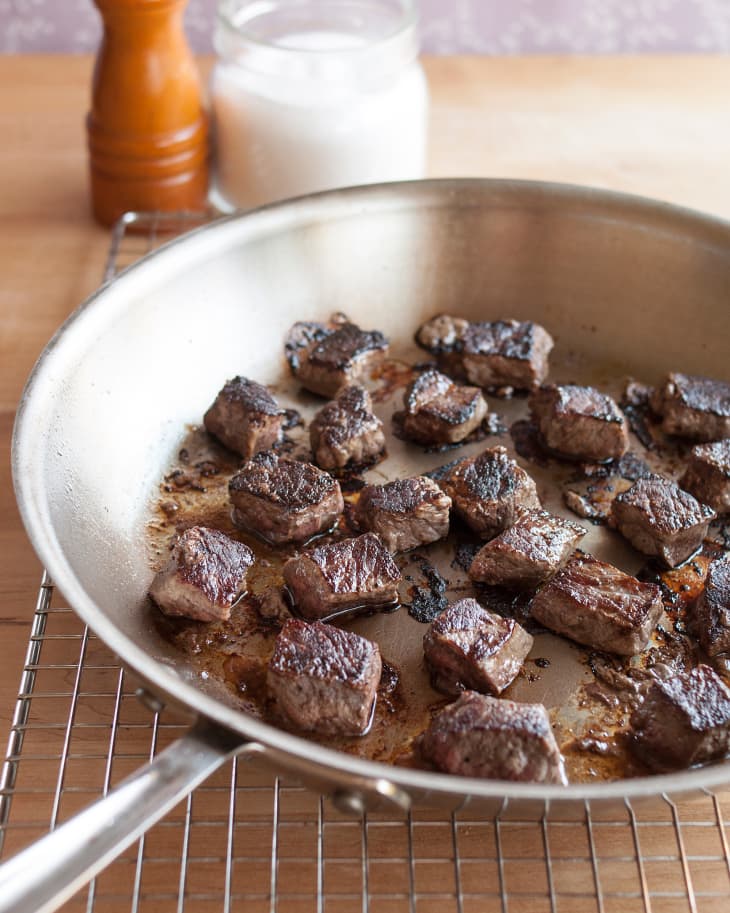
Searing meat is 100% about building season. And oh, what flavour it is! When that meat hits a scorching hot pan, the surface instantly begins caramelizing. In your stew or braise or roast, this translates into the kind of deep, savory flavor that we require on an nigh a cellular level. This is the flavor that makes u.s. want to lick our plates make clean. No sear, no plate-licking good times. Hither's how to do it.
Searing meat might seem like an unnecessary and time-consuming footstep in a recipe. Subsequently all, you're not actually cooking the meat here — that usually happens in the oven or as the stew simmers. You're also not sealing in juices — that's a myth. You lot're non actually doing much of anything, in fact — except building that sublime season.
How much can some caramelization action affect the flavor of your finished dish? Quite a lot. Imagine a steak that gets grilled over loftier heat: all those complex savory, nutty, deeply caramelized flavors! Now imagine a steak cooked over medium heat: grey and moist, tasting….utterly irksome. That aforementioned flavor (or lack of flavor) is what we're talking well-nigh in a braise or a soup.
I strongly experience that searing meat is worth the endeavour. Information technology's an extra fleck of work that results in a huge pay off in the flavour of your finished dish.
Convinced? Not convinced? Let'southward hash out in the comments. Meanwhile, here are some central pieces of advice to keep in mind:
Brand sure your pan is hot
High temperatures are needed to become a truly caramelized, deep-brown sear on the surface of the meat. Utilize a stainless steel or a cast iron skillet for this kind of cooking; avoid nonstick skillets. Add a few teaspoons of vegetable oil (which has a higher smoke signal) and set up the pan fix over high estrus. Pat the meat dry equally the pan heats — this helps keep it from steaming instead of searing. When the oil starts to shimmer and smoke just slightly, you lot're fix to add the meat.
Use a sparse coating of oil
When searing, the oil is less of a cooking medium and more of a way to go uniform surface contact between the meat and the pan. This volition requite you lot a overnice, fifty-fifty caramelization and forestall some spots from burning while other spots are still pale. Equally information technology'southward heating, swirl the oil around to get a sparse blanket over the bottom of the pan.
Don't crowd the pan
If you're cooking one large slice of meat, make sure to utilize a pan large enough to concord it. If you're cooking smaller pieces of meat, like for a stew, get out a few inches of space between the pieces of meat. This also ensures fifty-fifty cooking and prevents crowded meat from steaming instead of searing.
Resist the temptation to fuss
Once you've put the meat in the pan, let it exist. I know how tempting it is to take a summit under the meat or motility things effectually like we exercise for a sauté, but try to resist! Meat needs a few minutes of uninterrupted contact to properly sear — it will actually stick to the bottom of the pan at first and then release naturally when seared. After a few minutes, shake the pan. If the meat releases from the pan, information technology's prepare to be flipped to another side.
In one case you've seared all sides of the meat, y'all're set to transfer the meat to your braise, put it in the oven to roast, or go along with whatever cooking method your dish calls for.
- egg-free
- dairy-complimentary
- fish-free
- peanut-costless
- shellfish-free
- saccharide-conscious
- gluten-free
- tree-nut-free
- soy-costless
- wheat-free
- depression-sodium
Per serving, based on
4
servings. (% daily value)
- Calories 209
- Fat four.5 grand (half-dozen.9%)
- Saturated 1.eight k (viii.8%)
- Carbs xi.iii g (iii.viii%)
- Cobweb 2.9 g (xi.5%)
- Sugars 0.5 m
- Protein 20.8 g (41.7%)
- Sodium 103.8 mg (4.iii%)
Ingredients
- Beefiness , pork, lamb, chicken or any other meat
- Vegetable oil
- 1 loving cup red or white wine, broth, or h2o, to deglaze the pan
Equipment
- Heavy-bottomed stainless steal or cast fe skillet
- Tongs
- Potent spatula
Instructions
-
Choose the right pan: To properly sear meat, a stainless steel or bandage atomic number 26 skillet are the best. These can be heated to very high heat and help sear the meat evenly and apace. Enamel-lined pans and Dutch ovens can be used, just err for slightly lower heat as the enamel tin cleft. Do not apply not-stick pans for searing.
-
Prepare the meat: Gear up the meat in the manner yous're planning to cook it — chop large cuts of meat into bite-sized pieces for a stew, necktie up a roast with twine, so on.
-
Pat the meat dry: Pat the meat dry out with paper towels. This improves the contact between the pan and the meat and creates less steam during cooking.
-
Season with salt and pepper: Just before cooking, sprinkle the meat with salt and pepper. Expect to do this until y'all're ready to actually put the meat in the pan, otherwise the salt draws moisture out of the meat and you'll need to pat it dry once more.
-
Estrus the skillet to medium-high: Ready the skillet over medium-high to high heat. Subsequently you've seared a few batches, you'll know how high you can push information technology with your particular stove and your particular skillet. (On my electric stove, I outset at medium-high and stop up adjusting to down a few notches every bit the pan gets hot.)
-
Coat the pan with oil: Glaze the pan with plenty vegetable oil to film the lesser of the pan. When it shimmers and flows smoothly, it'southward ready.
-
Add the meat to the pan: Gently set the roast or pieces of meat in the pan. The meat should sizzle on contact and become "glued" to the bottom of the pan. If you are cooking pieces of meat, suit them in a single layer an inch or and so apart; cook in batches if necessary.
-
Let the meat sear without moving: For the first minute or two, do not move the meat. Do not try to pry information technology off the pan; just let it sizzle.
-
Flip the meat: In one case the showtime side has completely seared, it volition release easily from the pan. Milkshake the pan gently every and then often to see if it has released. When it does, flip the meat (or pieces of meat) to the other side. The seared surface should exist caramelized dark brownish. → If the glaze on the bottom of the pan starts looking very dry out or yous smell the odor of burning, lower the rut and add a fiddling more oil to the pan.
-
Continue searing the meat: Again, do not move the meat equally the second side sears. It volition release hands when it has seared. If you lot are cooking a roast, continue to cook on all sides. For smaller pieces of meat, cook the sides if desired, or transfer them to a clean plate and continue searing the remaining meat in batches; deglaze the pan betwixt batches (see below) and add together more oil as necessary.
-
Deglaze the pan: As the meat sears, a viscous brown glaze will start to build up on the lesser of the pan — this is called the "fond." Once you have finished searing, transfer all the meat to a clean plate and cascade one loving cup of wine, broth, or h2o into the pan. It should bubble and boil immediately and starting time dissolving the glaze. Scrape the bottom of the pan to work upward any tough $.25. If you lot're making a stew or braise, add this liquid to the rest of the liquid being used in the recipe. If y'all're making steaks or other quick-cooking meat dish, this liquid can exist reduced fifty-fifty further to make a pan-sauce to drizzle over the peak of the finished dish.
Desire more smart tutorials for getting things done around the abode?
See more How To posts
Nosotros're looking for neat examples of your own household intelligence also!
Submit your own tutorials or ideas hither!
(Images: Emma Christensen)
hinklelikeriatues.blogspot.com
Source: https://www.thekitchn.com/how-to-sear-meat-47333
0 Response to "How to Sear Cubes of Beef"
Post a Comment