Can Fossil Fuels Be Used Again
 | Look upwardly fossil fuel in Wiktionary, the free lexicon. |
A fossil fuel is a hydrocarbon-containing textile formed hush-hush from the remains of dead plants and animals that humans extract and burn as fuel. The main fossil fuels are coal, petroleum and natural gas,[1] which humans extract through mining and drilling. Fossil fuels may exist burnt to provide heat for utilise directly (e.g. for cooking), to power engines (such as internal combustion engines in motor vehicles), or to generate electricity.[2]
The principal origin of fossil fuels is the anaerobic decomposition of cached dead organisms, containing organic molecules created in aboriginal photosynthesis.[3] The transitions from these source materials to high-carbon fossil fuels typically requires a geological procedure of millions of years, sometimes more than 650 million years.[four]
Fossil fuels can be transformed into other chemicals or derivatives by the refining and chemical industries. Unremarkably-used refined fossil fuels include kerosene, gasoline and propane, and mutual chemicals include most plastics and agricultural chemicals such as fertilizers and pesticides. Equally of 2018, the world'due south main primary free energy sources consisted of petroleum (34%), coal (27%), and natural gas (24%), amounting to an 85% share for fossil fuels in chief energy consumption in the world. Non-fossil sources included nuclear (4.iv%), hydroelectric (half dozen.8%), and other renewable energy sources (four.0%, including geothermal, solar, tidal, air current, woods, and waste).[five] The share of renewable sources (including traditional biomass) in the world's full final free energy consumption was 18% in 2018.[6]
Fossil fuels cause serious environmental impairment and direct negative consequences on local communities at every stage in their employ: extraction, transportation and consumption of the fuels. Over 80% of the carbon dioxide (CO2) emitted by humans is from burning fossil fuels: effectually 35 billion tonnes (35 gigatonnes) a yr,[vii] compared to four gigatonnes from land use modify.[8] Natural processes on World (mostly through assimilation by the ocean) can only absorb a small-scale role of this amount, therefore there is a cyberspace increase of many billion tonnes of atmospheric carbon dioxide per year.[ix] Carbon dioxide is a greenhouse gas that increases radiative forcing, thus fossil fuels are the master source of greenhouse gas emissions causing global warming and bounding main acidification. Additionally, most air pollution deaths are due to fossil fuel particulates and noxious gases: it is estimated that this pollution costs over 3% of global GDP,[10] and that fossil fuel phase-out would relieve 3.half dozen one thousand thousand lives each year.[11]
Recognition of the climate crisis, pollution and other negative impacts caused by fossil fuels has led to a widespread policy transition and activist motion focused on catastrophe their use in favor of renewable energy. However, because the fossil fuel industry is and so important to the global economy and historically heavily subsidized, this transition is expected to have significant economic impacts. Many stakeholders argue that this alter needs to exist a only transition and create policy that addresses the stranded assets of the fossil fuel industry. International policy, in the form of Sustainable Development Goal 7: Affordable and Clean Free energy, Sustainable Development Goal thirteen: Climate Action and the Paris Climate Agreement, is designed to facilitate this transition at a global level. In 2021, the International Energy Bureau concluded that no new fossil fuel extraction projects could exist opened if the global economy and society wants to avoid the worst impacts of climate change and meet international goals for climate change mitigation.[12]
Origin
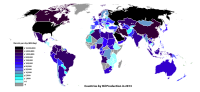
Since oil fields are located only at sure places on earth,[13] only some countries are oil-independent; the other countries depend on the oil-production capacities of these countries
The theory that fossil fuels formed from the fossilized remains of expressionless plants by exposure to heat and pressure in Earth's crust over millions of years was first introduced by Andreas Libavius "in his 1597 Alchemia [Alchymia]" and after past Mikhail Lomonosov "as early as 1757 and certainly by 1763".[fourteen] The offset use of the term "fossil fuel" occurs in the work of the German chemist Caspar Neumann, in English translation in 1759.[15] The Oxford English Dictionary notes that in the phrase "fossil fuel" the adjective "fossil" means "[o]btained by excavation; plant buried in the earth", which dates to at to the lowest degree 1652,[sixteen] before the English substantive "fossil" came to refer primarily to long-dead organisms in the early 18th century.[17]
Aquatic phytoplankton and zooplankton that died and sedimented in large quantities under anoxic weather millions of years ago began forming petroleum and natural gas as a result of anaerobic decomposition. Over geological time this organic matter, mixed with mud, became buried under farther heavy layers of inorganic sediment. The resulting high temperature and pressure caused the organic affair to chemically change, get-go into a waxy fabric known as kerogen, which is found in oil shales, and then with more rut into liquid and gaseous hydrocarbons in a process known as catagenesis. Despite these heat-driven transformations (which increase the free energy density compared to typical organic matter by removal of oxygen atoms),[18] the free energy released in combustion is yet photosynthetic in origin.[three]
Terrestrial plants tended to grade coal and methyl hydride. Many of the coal fields date to the Carboniferous period of World's history. Terrestrial plants also course type 3 kerogen, a source of natural gas. Although fossil fuels are continually formed by natural processes, they are classified every bit not-renewable resource because they have millions of years to form and known viable reserves are beingness depleted much faster than new ones are generated.[19] [20]
There is a wide range of organic compounds in any given fuel. The specific mixture of hydrocarbons gives a fuel its characteristic properties, such equally density, viscosity, humid point, melting point, etc. Some fuels, like natural gas, for case, contain only very low humid, gaseous components. Others such as gasoline or diesel fuel contain much college humid components.
Importance
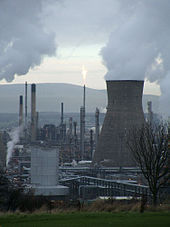
Fossil fuels are of corking importance because they can be burned (oxidized to carbon dioxide and water), producing pregnant amounts of free energy per unit mass. The use of coal as a fuel predates recorded history. Coal was used to run furnaces for the smelting of metal ore. While semi-solid hydrocarbons from seeps were also burned in ancient times,[21] they were mostly used for waterproofing and embalming.[22]
Commercial exploitation of petroleum began in the 19th century, largely to supplant oils from beast sources (notably whale oil) for utilize in oil lamps.[23] [ amend source needed ]
Natural gas, in one case flared-off equally an unneeded byproduct of petroleum production, is at present considered a very valuable resource.[24] Natural gas deposits are as well the master source of helium.
Heavy crude oil, which is much more than gummy than conventional crude oil, and oil sands, where bitumen is plant mixed with sand and dirt, began to go more of import as sources of fossil fuel in the early 2000s.[25] Oil shale and similar materials are sedimentary rocks containing kerogen, a complex mixture of high-molecular weight organic compounds, which yield constructed crude oil when heated (pyrolyzed). With boosted processing, they can be employed instead of other established fossil fuels. During the 2010s and 2020s there was disinvestment from exploitation of such resources due to their high carbon cost relative to more easily-processed reserves.[26]
Prior to the latter half of the 18th century, windmills and watermills provided the energy needed for work such as milling flour, sawing wood or pumping water, while burning wood or peat provided domestic heat. The wide-scale use of fossil fuels, coal at first and petroleum later, in steam engines enabled the Industrial Revolution. At the aforementioned time, gas lights using natural gas or coal gas were coming into wide utilize. The invention of the internal combustion engine and its use in automobiles and trucks greatly increased the demand for gasoline and diesel oil, both made from fossil fuels. Other forms of transportation, railways and aircraft, too require fossil fuels. The other major use for fossil fuels is in generating electricity and as feedstock for the petrochemical industry. Tar, a leftover of petroleum extraction, is used in the structure of roads.
Ecology effects

The Global Carbon Project shows how additions to CO2 since 1880 take been acquired past different sources ramping up i after some other.
The burning of fossil fuels has a number of negative externalities – harmful environmental impacts where the furnishings extend beyond the people using the fuel. The actual effects depend on the fuel in question. All fossil fuels release COtwo when they burn, thus accelerating climatic change. Burning coal, and to a lesser extent oil and its derivatives, contribute to atmospheric particulate affair, smog and acid rain.[27] [28] [29]

Global surface temperature reconstruction over the last 2000 years using proxy data from tree rings, corals, and ice cores in blue.[xxx] Straight observational information is in red, with all data showing a 5 year moving average.[31]
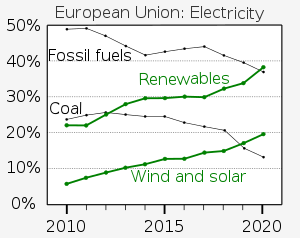
In 2020, renewables overtook fossil fuels as the European Union's chief source of electricity for the first time.[32]
Climatic change is largely driven past the release of greenhouse gasses like CO2, with the called-for of fossil fuels being the main source of these emissions. In well-nigh parts of the world climate change is negatively impacting ecosystems.[33] This includes contributing to the extinction of species (meet also extinction risk from global warming) and reducing people's ability to produce food, thus calculation to the problem of globe hunger. Connected rises in global temperatures will pb to further adverse effects on both ecosystems and people, with the World Health Organization having stated climate change is the greatest threat to human health in the 21st century.[34] [35]
Combustion of fossil fuels generates sulfuric and nitric acids, which fall to Earth as acid rain, impacting both natural areas and the built environs. Monuments and sculptures made from marble and limestone are particularly vulnerable, equally the acids deliquesce calcium carbonate.
Fossil fuels likewise contain radioactive materials, mainly uranium and thorium, which are released into the atmosphere. In 2000, about 12,000 tonnes of thorium and five,000 tonnes of uranium were released worldwide from burning coal.[36] It is estimated that during 1982, US coal burning released 155 times every bit much radioactive decay into the temper as the 3 Mile Island accident.[37]
Burning coal also generates large amounts of lesser ash and wing ash. These materials are used in a wide variety of applications (see Wing ash reuse), utilizing, for case, most 40% of the Usa production.[38] [ dead link ]
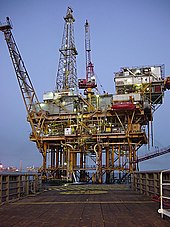
In add-on to the effects that consequence from called-for, the harvesting, processing, and distribution of fossil fuels also have environmental furnishings. Coal mining methods, particularly mountaintop removal and strip mining, take negative ecology impacts, and offshore oil drilling poses a gamble to aquatic organisms. Fossil fuel wells can contribute to marsh gas release via fugitive gas emissions. Oil refineries also take negative environmental impacts, including air and water pollution. Coal is sometimes transported by diesel-powered locomotives, while crude oil is typically transported by tanker ships, requiring the combustion of additional fossil fuels.
A diverseness of mitigating efforts have arisen to counter the negative furnishings of fossil fuels. This includes a motion to use alternative energy sources, such as renewable energy. Environmental regulation uses a diverseness of approaches to limit these emissions; for case, rules confronting releasing waste product products like fly ash into the atmosphere. Other efforts include economic incentives, such as increased taxes for fossil fuels, and subsidies for alternative energy technologies like solar panels.[29] [ better source needed ]
In December 2020, the United Nations released a study saying that despite the need to reduce greenhouse emissions, diverse governments are "doubling downward"[ colloquialism ] on fossil fuels, in some cases diverting over 50% of their COVID-19 recovery stimulus funding to fossil fuel product rather than to alternative free energy. The UN secretary general António Guterres declared that "Humanity is waging war on nature. This is suicidal. Nature always strikes back – and it is already doing so with growing forcefulness and fury." However, Guterres also said there is still cause for promise, anticipating Joe Biden's plan for the United states of america to bring together other large emitters like Cathay and the European union in adopting targets to accomplish internet nix emissions past 2050.[39] [twoscore] [41]
Affliction and deaths
Environmental pollution from fossil fuels impacts humans considering particulates and other air pollution from fossil fuel combustion crusade illness and death when inhaled. These health furnishings include premature death, astute respiratory illness, aggravated asthma, chronic bronchitis and decreased lung function. The poor, undernourished, very young and very erstwhile, and people with preexisting respiratory illness and other sick health are more at chance.[42] Global air pollution deaths due to fossil fuels in 2018 accept been estimated at over 8 million people, most ane in v deaths worldwide.[43]
While all energy sources inherently have adverse furnishings, the data shows that fossil fuels crusade the highest levels of greenhouse gas emissions and are the nearly dangerous for human health. In contrast, modern renewable free energy sources appear to be safer for human health and cleaner. The death charge per unit from accidents and air pollution in the EU are as follows per terawatt-hour: coal (24.6 deaths), oil (xviii.4 deaths), natural gas (2.eight deaths), biomass (four.6 deaths), hydropower (0.02 deaths), nuclear energy (0.07 deaths), current of air (0.04 deaths), and solar (0.02 deaths). The greenhouse gas emissions from each energy source are as follows, measured in tonnes: coal (820 tonnes), oil (720 tonnes), natural gas (490 tonnes), biomass (78-230 tonnes), hydropower (34 tonnes), nuclear energy (3 tonnes), wind (4 tonnes), and solar (five tonnes).[44] Every bit the data shows, coal, oil, natural gas, and biomass cause college death rates and higher levels of greenhouse gas emissions than hydropower, nuclear energy, air current, and solar power. Scientists propose that 1.8 million lives accept been saved past replacing fossil fuel sources with nuclear ability.[45]
Phase-out
Just transition
Divestment

As of 2021, ane,300 institutions possessing fourteen.6 trillion dollars divested from the fossil fuel industry.[49]
Fossil fuel divestment or fossil fuel divestment and investment in climate solutions is an endeavor to reduce climate change by exerting social, political, and economic pressure level for the institutional divestment of assets including stocks, bonds, and other financial instruments connected to companies involved in extracting fossil fuels.
Fossil fuel divestment campaigns emerged on campuses in the United states in 2011 with students urging their administrations to turn endowment investments in the fossil fuel manufacture into investments in make clean energy and communities most impacted by climate change.[50] In 2012, Unity Higher in Maine became the first institution of higher learning to divest[51] its endowment from fossil fuels.
Past 2015, fossil fuel divestment was reportedly the fastest growing divestment movement in history.[52] In October 2021, a total of 1,485 institutions representing $39.2 trillion in assets worldwide had begun or committed to a divestment from fossil fuels.[53]
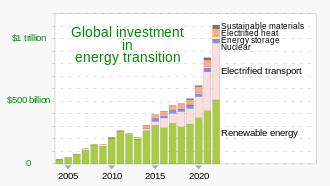
Investment: Companies, governments and households invested $501.3 billion in decarbonization in 2020, including renewable free energy (solar, wind), electric vehicles and associated charging infrastructure, free energy storage, energy-efficient heating systems, carbon capture and storage, and hydrogen.[54]
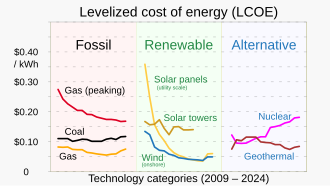
Cost: With increasingly widespread implementation of renewable energy sources, costs have declined, virtually notably for free energy generated by solar panels.[55]
Levelized cost of energy (LCOE) is a measure of the boilerplate net nowadays toll of electricity generation for a generating institute over its lifetime.
Energy sector
In 2019, Saudi Aramco was listed and it reached a US$2 trillion valuation on its 2nd twenty-four hours of trading,[56] after the earth's largest initial public offering.[57]
Economic effects
Air pollution from fossil fuels in 2018 has been estimated to cost Usa$ii.ix trillion, or 3.3% of global GDP.[10]
Subsidies
Run across also
- Abiogenic petroleum origin proposes that petroleum is non a fossil fuel
- Bioremediation
- Carbon bubble
- Environmental affect of the free energy industry
- Externality
- Fossil Fools Day
- Fossil Fuel Beta
- Fossil fuel divestment
- Fossil fuel drilling
- Fossil fuel exporters
- Fossil fuel phase-out
- Fossil fuels anteroom
- Fugitive gas emissions
- Hydraulic fracturing
- Liquefied petroleum gas
- Low-carbon power
- Peak coal
- Peak gas
- Petroleum industry
- Phase-out of fossil fuel vehicles
- Eco-economic decoupling
- Shale gas
- Oil shale
Footnotes
- ^ "Fossil fuel". ScienceDaily . Retrieved 29 October 2021.
- ^ "Fossil fuels". Geological Survey Ireland. Retrieved 29 October 2021.
- ^ a b "thermochemistry of fossil fuel formation" (PDF).
- ^ Paul Isle of mann, Lisa Gahagan, and Mark B. Gordon, "Tectonic setting of the globe's giant oil and gas fields", in Michel T. Halbouty (ed.) Giant Oil and Gas Fields of the Decade, 1990–1999, Tulsa, Okla.: American Clan of Petroleum Geologists, p. 50, accessed 22 June 2009.
- ^ "Chief energy: consumption by fuel". BP Statistical Review of World Energy 2019. BP. 2019. p. ix. Retrieved vii Jan 2020.
- ^ World Bank, International Energy Agency, Energy Sector Management Help Programme. "Renewable energy consumption (% of total terminal energy consumption) | Data". data.worldbank.org. Globe Banking company. Retrieved 12 February 2019.
{{cite web}}: CS1 maint: uses authors parameter (link) - ^ Ambrose, Jillian (12 April 2020). "Carbon emissions from fossil fuels could autumn by two.5bn tonnes in 2020". The Guardian. ISSN 0261-3077. Retrieved 27 April 2020.
- ^ "Global Carbon Project (GCP)". www.globalcarbonproject.org . Retrieved 5 April 2022.
- ^ "What Are Greenhouse Gases?". Us Department of Energy . Retrieved nine September 2007.
- ^ a b "Quantifying the Economic Costs of Air Pollution from Fossil Fuels" (PDF). Archived from the original (PDF) on 6 April 2020.
- ^ Zhang, Sharon. "Air Pollution Is Killing More People Than Smoking—and Fossil Fuels Are Largely to Blame". Pacific Standard . Retrieved 5 Feb 2020.
- ^ "No new oil, gas or coal evolution if earth is to attain net nada by 2050, says world energy body". the Guardian. 18 May 2021. Retrieved 15 October 2021.
- ^ Oil fields map Archived vi August 2012 at the Wayback Machine. quakeinfo.ucsd.edu
- ^ Hsu, Chang Samuel; Robinson, Paul R. (2017). Springer Handbook of Petroleum Technology (2nd, illustrated ed.). Springer. p. 360. ISBN978-3-319-49347-3. Extract of p. 360
- ^ Caspar Neumann; William Lewis (1759). The Chemical Works of Caspar Neumann ... (1773 printing). J. and F. Rivington. pp. 492–.
- ^ "fossil". Oxford English Dictionary (Online ed.). Oxford Academy Press. (Subscription or participating institution membership required.) - "fossil [...] adj. [...] Obtained by digging; found buried in the earth. At present importantly of fuels and other materials occurring naturally in underground deposits; esp. in FOSSIL FUEL n."
- ^ "fossil". Oxford English Dictionary (Online ed.). Oxford Academy Press. (Subscription or participating institution membership required.) - "fossil [...] northward. [...] Something preserved in the ground, esp. in petrified course in rock, and recognizable as the remains of a living organism of a old geological flow, or as preserving an impression or trace of such an organism."
- ^ Schmidt-Rohr, Chiliad. (2015). "Why Combustions Are Always Exothermic, Yielding About 418 kJ per Mole of O2", J. Chem. Educ. 92: 2094-2099. http://dx.doi.org/10.1021/acs.jchemed.5b00333
- ^ Miller, Yard.; Spoolman, Scott (2007). Environmental Science: Problems, Connections and Solutions. Cengage Learning. ISBN978-0-495-38337-6 . Retrieved fourteen Apr 2018 – via Google Books.
- ^ Ahuja, Satinder (2015). Nutrient, Energy, and Water: The Chemistry Connection. Elsevier. ISBN978-0-12-800374-9 . Retrieved 14 April 2018 – via Google Books.
- ^ "Encyclopædia Britannica, apply of oil seeps in aboriginal times". Retrieved nine September 2007.
- ^ Bilkadi, Zayn (1992). "Bulls From the Sea: Ancient Oil Industries". Aramco World. Archived from the original on 13 Nov 2007.
- ^ Ball, Max Due west.; Douglas Ball; Daniel South. Turner (1965). This Fascinating Oil Business concern. Indianapolis: Bobbs-Merrill. ISBN978-0-672-50829-five.
- ^ Kaldany, Rashad, Managing director Oil, Gas, Mining and Chemicals Dept, World Bank (13 Dec 2006). Global Gas Flaring Reduction: A Time for Action! (PDF). Global Forum on Flaring & Gas Utilization. Paris. Retrieved nine September 2007.
- ^ "Oil Sands Global Market place Potential 2007". Retrieved 9 September 2007.
- ^ Editor, Damian Carrington Environment (12 December 2017). "Insurance giant Axa dumps investments in tar sands pipelines". The Guardian . Retrieved 24 Dec 2017.
- ^ Oswald Spengler (1932). Man and Technics (PDF). Alfred A. Knopf. ISBN0-8371-8875-X. Archived from the original (PDF) on 12 November 2020. Retrieved seven December 2020.
- ^ Griffin, Rodman (ten July 1992). "Culling Energy". ii (2): 573–596.
- ^ a b Michael Stephenson (2018). Energy and Climatic change: An Introduction to Geological Controls, Interventions and Mitigations. Elsevier. ISBN978-0128120217.
- ^ Neukom, Raphael; Barboza, Luis A.; Erb, Michael P.; Shi, Feng; et al. (2019). "Consistent multidecadal variability in global temperature reconstructions and simulations over the Common Era". Nature Geoscience. 12 (8): 643–649. Bibcode:2019NatGe..12..643P. doi:ten.1038/s41561-019-0400-0. ISSN 1752-0908. PMC6675609. PMID 31372180.
- ^ "Global Almanac Mean Surface Air Temperature Change". NASA. Retrieved 23 February 2020.
- ^ "The European Ability Sector in 2020 / Up-to-Date Assay on the Electricity Transition" (PDF). ember-climate.org. Ember and Agora Energiewende. 25 January 2021. Archived (PDF) from the original on 25 January 2021.
- ^ EPA (xix January 2017). "Climate Impacts on Ecosystems". Retrieved 7 December 2020.
- ^ "WHO calls for urgent activity to protect wellness from climate change". World Health System. November 2015. Archived from the original on 8 Oct 2015. Retrieved 7 December 2020.
- ^ World Meteorological Organization (2020). WMO Statement on the State of the Global Climate in 2019. WMO-No. 1248. Geneva. ISBN978-92-63-11248-4.
- ^ Coal Combustion: Nuclear Resource or Danger Archived five Feb 2007 at the Wayback Machine – Alex Gabbard
- ^ Nuclear proliferation through coal called-for Archived 27 March 2009 at the Wayback Car – Gordon J. Aubrecht, 2, Ohio State University
- ^ American Coal Ash Clan. "CCP Production and Use Survey" (PDF). [ permanent dead link ]
- ^ Damian Carrington (2 Dec 2020). "World is 'doubling downwards' on fossil fuels despite climate crunch – Un report". The Guardian . Retrieved 7 December 2020.
- ^ Fiona Harvey (2 December 2020). "Humanity is waging state of war on nature, says United nations secretary full general". The Guardian . Retrieved seven Dec 2020.
- ^ "The Product Gap: The discrepancy between countries' planned fossil fuel product and global production levels consistent with limiting warming to 1.5°C or ii°C". UNEP. December 2020. Retrieved 7 December 2020.
- ^ Liodakis, E; Dashdorj, Dugersuren; Mitchell, Gary East. (2011). The nuclear alternative: Energy Production within Ulaanbaatar, Mongolia. AIP Conference Proceedings. Vol. 1342. p. 91. Bibcode:2011AIPC.1342...91L. doi:x.1063/1.3583174.
- ^ February 19; Chaisson, 2021 Clara. "Fossil Fuel Air Pollution Kills 1 in Five People". NRDC . Retrieved 5 Apr 2022.
- ^ "What are the safest and cleanest sources of energy?". Our World in Data . Retrieved 29 Dec 2020.
- ^ Jogalekar, Ashutosh. "Nuclear power may have saved one.8 meg lives otherwise lost to fossil fuels, may relieve up to vii million more than". Scientific American Blog Network . Retrieved 29 December 2020.
- ^ Green, F., & Denniss, R. (2018). "Cutting with both artillery of the scissors: the economic and political case for restrictive supply-side climate policies". Climate change. 150 (i): 73–87. Bibcode:2018ClCh..150...73G. doi:10.1007/s10584-018-2162-10. S2CID 59374909. Archived from the original on 2 November 2021. Retrieved two November 2021.
{{cite journal}}: CS1 maint: multiple names: authors list (link) - ^ "Climate Frontlines Conference - No Jobs on a Dead Planet" (PDF). International Trade Union Confederation. March 2015. Retrieved 27 March 2020.
- ^ "Just Transition Platform". European Commission - European Commission . Retrieved 19 August 2020.
- ^ "Divestment Commitments". Gofossilfree.org . Retrieved 11 Apr 2020.
- ^ Gibson, Dylan; Duram, Leslie (2020). "Shifting Discourse on Climate and Sustainability: Key Characteristics of the Higher Education Fossil Fuel Divestment Movement". Sustainability. 12 (23): 10069. doi:x.3390/su122310069.
- ^ "Divestment from Fossil Fuels". Unity Higher . Retrieved 29 December 2021.
- ^ "Fossil fuel divestment: a brief history". The Guardian . Retrieved 25 March 2015.
- ^ "1485 institutions with assets over $39.2 Trillion have committed to divest from fossil fuels". Stand up.earth. 26 Oct 2021. Retrieved 1 December 2021.
- ^ "Free energy Transition Investment Hitting $500 Billion in 2020 – For First Fourth dimension". BloombergNEF. (Bloomberg New Energy Finance). 19 January 2021. Archived from the original on 19 January 2021.
- ^ Chrobak, Ula (writer); Chodosh, Sara (infographic) (28 January 2021). "Solar power got cheap. So why aren't nosotros using it more?". Popular Scientific discipline. Archived from the original on 29 January 2021. ● Chodosh's graphic is derived from data in "Lazard's Levelized Toll of Energy Version 14.0" (PDF). Lazard.com. Lazard. xix October 2020. Archived (PDF) from the original on 28 January 2021.
- ^ Kerr, Simeon; Massoudi, Arash; Raval, Anjli (xix December 2019). "Saudi Aramco touches $2tn valuation on second day of trading". Fiscal Times . Retrieved ten January 2020.
- ^ Raval, Anjli; Kerr, Simeon; Stafford, Philip (5 December 2019). "Saudi Aramco raises $25.6bn in world's biggest IPO". Financial Times . Retrieved ten January 2020.
- ^ "Update on recent progress in reform of inefficient fossil-fuel subsidies that encourage wasteful consumption" (PDF). 2021.
- ^ George, Johannes Urpelainen and Elisha (14 July 2021). "Reforming global fossil fuel subsidies: How the United States tin can restart international cooperation". Brookings . Retrieved 26 February 2022.
- ^ Brower, Derek; Wilson, Tom; Giles, Chris (25 February 2022). "The new free energy daze: Putin, Ukraine and the global economy". Financial Times . Retrieved 26 Feb 2022.
- ^ "Free energy subsidies". International Free energy Agency . Retrieved 26 February 2022.
- ^
- ^ John Schwartz (5 December 2015). "On Tether to Fossil Fuels, Nations Speak With Money". The New York Times. Archived from the original on half-dozen Dec 2015. Retrieved 5 Dec 2015.
...the elimination of subsidies as one of the nearly effective strategies for reducing greenhouse gas emissions.
- ^ Ross, Michael L.; Hazlett, Chad; Mahdavi, Paasha (January 2017). "Global progress and backsliding on gasoline taxes and subsidies". Nature Energy. 2 (i): 16201. Bibcode:2017NatEn...216201R. doi:10.1038/nenergy.2016.201.
- ^ "Fossil fuel subsidies: If we want to reduce greenhouse gas emissions nosotros should not pay people to burn fossil-fuels". Our Earth in Data . Retrieved 4 November 2021.
- ^ "Local Environmental Externalities due to Energy Cost Subsidies: A Focus on Air Pollution and Health" (PDF). World Bank.
- ^ "Protecting Nature by Reforming Environmentally Harmful Subsidies: The Role of Business | World Track". world wide web.earthtrack.net . Retrieved 7 March 2022.
Further reading
- Ross Barrett and Daniel Worden (eds.), Oil Civilization. Minneapolis, MN: Academy of Minnesota Press, 2014.
- Bob Johnson, Carbon Nation: Fossil Fuels in the Making of American Civilisation. Lawrence, KS: University Printing of Kansas, 2014.
External links
- Global Fossil Infrastructure Tracker
- Middle for Research on Energy and Clean Air
hinklelikeriatues.blogspot.com
Source: https://en.wikipedia.org/wiki/Fossil_fuel
0 Response to "Can Fossil Fuels Be Used Again"
Post a Comment